
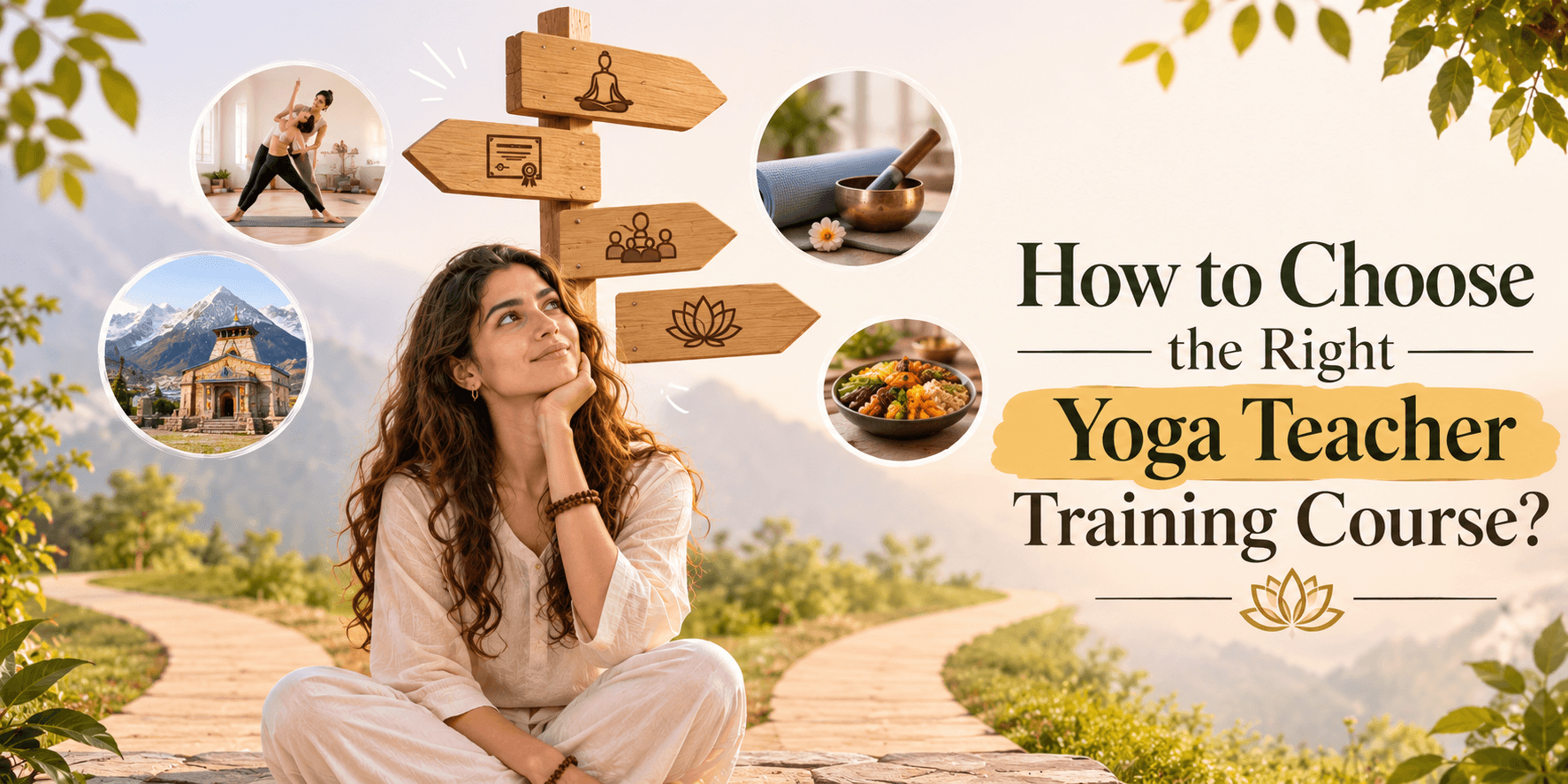
Yoga is not just a term we use simply for stretching and body exercises; it has grown into a big educational industry called a yoga teacher training course. Yoga is being practised as a serious discipline that people are now studying for mental and physical health, clarity of mind, as well as a career path in teaching. As we all know, Rishikesh is one of the most popular yoga destinations for choosing a yoga school or practising yoga for personal development. This written guide will help you choose the right yoga teacher training course, as there are many yoga courses available throughout the internet that run weekly. These courses are short, long and even month-long.
Which one to choose? Still confused? In this written guide, you will know the steps that will help you decide which course will be best for you. The goal here is not to sell you a specific program. It is to help you figure out what the “right yoga course” will be for your personal and professional goals.
Always start with: What do you actually want from the yoga teacher training course?
Your first goal should be to find what yoga teacher training course you actually want. Before choosing a yoga school or comparing the style, fees and duration of the course, you need to look for the right course and purpose. Yoga courses generally serve one, two or more of these purposes:
- Personal practice – for a few people, yoga is about personal practice and self-awareness. You can go for a 100 Hour Yoga Teacher Training Course.
- Career building – if you want to become a yoga teacher or want a yoga instructor certification as your profession, or want to work as a part-time wellness instructor, you can do a 200 hour yoga teacher training.
- Deeper knowledge and in-depth philosophy – when you want to study yoga in depth, not only to teach but to understand yoga to its root, philosophy and practice it beyond the physical postures, you can go for an advanced course like 300 Hour Yoga Teacher Training.
These are a few of the best yoga teacher training courses you will find throughout the internet or the yoga schools. Now you know the purpose of each yoga teacher training course.
Start your journey: Where to start your yoga teacher training course journey?
Beginner or an Experienced practitioner? You have to start somewhere. As we all know, when the topic is “Yoga”, the destination that comes to mind is Rishikesh. Especially when you are about to start your yoga journey as a beginner, Rishikesh is always the best option for your yoga teacher training course journey. Now the question is, “Why Rishikesh”? This written guide will help you understand why:
- Rishikesh and its roots in yoga are thousands of years old. A good strategy for your beginners yoga course.
- Rishikesh has some of the best yoga schools in India, which makes it a benchmark for yoga teacher training courses.
- Authentic yoga schools with multi-style yoga teacher training.
- The Yoga Town is well known for its 200 hour yoga teacher training in Rishikesh.
- One of the most important things Rishikesh carry is the legacy of experienced yoga teachers from generations.
- End number of options, whichever suits your time.
- Beginner or an Experienced practitioner, no matter who you are, Rishikesh will always be the place where yoga flows for everyone.
By now, you will be clear about where you can start your yoga teacher training course journey.
Are you a Beginner or an Experienced Practitioner?
When you go across the internet, you will find that many yoga teacher training courses say “suitable for all”, which is just a marketing strategy followed by many yoga schools. You should know where you stand:
- Complete beginners: As a complete beginner, you can go for a 100 hour yoga teacher training course in Rishikesh. This complete beginner’s course will start with a slow pace and will make your basics of yoga clear.
- Intermediate practitioners: This course is for all of you who want to start a journey of yoga as a teacher or want to become a part-time yoga instructor. A 200 hour yoga teacher training program will be the best option to prepare yourself.
- Advanced and Experienced practitioners: If you are an Advanced or Experienced practitioner and you want to learn yoga and its philosophy to its core, you can go for a 300 Hour Yoga Teacher Training in Rishikesh, the place where many great yogi practitioners learned yoga.
You must be practical here, not get inspired by great stories. Inspiration is important, so is practicality. You must be clear about where you are standing and which level of yoga teacher training course will be suitable for you.
Which Yoga Styles and Teaching Approaches are for you?
“Yoga” is a broad term, not just a few poses or a yoga teacher training course. There are many different physical and philosophical approaches.
- Hatha – A slow, foundational style that teaches classic postures, breathing and alignment, ideal for beginners building a strong base.
- Vinyasa – A dynamic, flowing style that links breath with movement, ideal for those who enjoy creative sequencing and energetic classes.
- Ashtanga – A disciplined, structured series of postures practised in a fixed order, ideal for those who like rigour, strength and routine.
- Iyengar – A precision-focused style that uses props and detailed alignment, ideal for those who value technical depth and safe, accurate teaching.
- Yin – A calm, slow-paced style with long-held floor postures that target deep connective tissue, ideal for those drawn to stillness, flexibility and mindfulness.
- Traditional approach – A holistic path rooted in yogic philosophy, pranayama, meditation and lifestyle, ideal for those who want authentic, in-depth learning beyond physical postures.
Till now you will be ready for what yoga styles and teaching approaches you have to choose for your yoga teacher training course.
What is the duration of the course? Does it match your time and Goal?
When you are looking for a yoga teacher training course, one of the most important things is what is the duration of the course and does it matches your goal and time you want to invest in it. The duration will tell you how much time you will need to invest, and the curriculum will tell you what you will actually learn. The courses are divided into three categories:
- Short Duration Courses, workshops or retreats – basically a yoga retreat or 100 hour yoga course.
- Foundation Courses and yoga teacher training programs– based on your interest and the time it usually requires, at least a 3-week training schedule.
- Advanced Course and specialisation course- this course is generally for yoga enthusiasts who can invest at least a month in this training schedule.
You would know, so far which course you want to select on the basis of your interest, time and style.
What a Good Curriculum Actually Includes?
What is a good curriculum? What does it actually look like? Almost every yoga school provides you with a basic understanding of a yoga teacher training course. But when it comes to yoga teacher training, like a 200 Hour Yoga TTC in Rishikesh, a good curriculum includes:
| S.No | Subjects | Topic Covered |
| 1 | Hatha Yoga | Basic and intermediate asanas, alignment, posture techniques, benefits and modifications |
| 2 | Ashtanga Vinyasa Yoga | Primary Series, Surya Namaskar A & B, Vinyasa transitions, Drishti and Bandhas |
| 3 | Pranayama | Nadi Shodhana, Kapalabhati, Bhastrika, Bhramari, Ujjayi and Sheetali |
| 4 | Shatkarma | Jala Neti, Sutra Neti, Trataka, Dhauti, Nauli and Basti |
| 5 | Meditation | Mindfulness, Mantra Meditation, Chakra Meditation, Trataka and Yoga Nidra |
| 6 | Yoga Philosophy | Patanjali Yoga Sutras, Bhagavad Gita, Eight Limbs of Yoga, Yama and Niyama |
| 7 | Anatomy & Physiology | Skeletal system, muscular system, respiratory system, nervous system and biomechanics |
| 8 | Ayurveda | Three Doshas, Pancha Mahabhuta, Sattvic diet and Dinacharya |
| 9 | Alignment & Teaching Methodology | Posture alignment, adjustments, teaching techniques, class planning and sequencing |
| 10 | Mantra Chanting & Sanskrit | Om chanting, Guru Mantra, Shanti Mantra and Sanskrit pronunciation |
| 11 | Practical Teaching | Teaching practice, demonstration, classroom management, lesson planning and assessment |
Now you must know almost everything you need to know before choosing a yoga teacher training course. Further, you will learn a few more things you need to look for.
Teacher Qualification and Certification
Before enrolling in any yoga teacher training course, you must look for the qualifications and certification of teachers at the yoga school. Why it is important and what Rishikesh offers you:
- In Rishikesh, you learn from certified and experienced yoga teachers with years of practical knowledge.
- Teachers bring traditional wisdom and a genuine passion for teaching.
- A student-focused approach guides you through every aspect of yoga.
- Training covers asanas, pranayama, meditation, yoga philosophy, anatomy and teaching methodology.
- Personal guidance and hands-on corrections help refine your practice.
- A supportive teaching style builds your confidence and deepens your understanding of yoga beyond the mat.
- You are prepared to become a knowledgeable and confident yoga teacher.
How can you compare schools for a yoga teacher training course?
The following are ways you can compare schools for a yoga teacher training course:
- Location and Environment
- Learning Schedule and learning environment
- Batch Sizes ( A very important factor)
- Accommodation and Food
- Teachers’ Qualifications
- Yoga School Registration ( Is the school Yoga Alliance Certified)
- Curriculum and Teaching Approach
- Reviews ( You can go for it, but in today’s world, everything can be manipulated); believe in your gut feeling.
- Cost, and what exactly is included in that price. (Expensive does not always mean better)
What are the questions you need to ask before enrolling on any yoga school?
Here are a few questions you can ask before enrolling on any yoga school:
- Is the Yoga School Registered with Yoga Alliance?
- Who Are the Yoga Teachers, and What Are Their Qualifications?
- What Is Included in the Yoga Teacher Training Curriculum?
- How Much Does Yoga Teacher Training in Rishikesh Cost?
- What Type of Accommodation and Food Does the Yoga School Provide?
- Do I Need Previous Yoga Experience or Flexibility to Join?
- How Much Practical Teaching Experience Will I Get?
- What Is the Daily Schedule of a Yoga Teacher Training Course?
- What Certification Will I Receive After Completing the Course?
- What Facilities and Additional Activities Does the Yoga School Offer?
Conclusion
Choosing the right yoga teacher training course is a deeply personal journey that depends on your goals, experience level, and commitment to personal growth. By carefully considering the style, duration, curriculum, and authenticity of the school, you set yourself up for a transformative experience in yoga. If you are looking for an authentic and enriching learning environment in Rishikesh, Sriezaa Yogshala stands out for its experienced teachers, supportive community, and dedication to traditional yogic wisdom. Trust your intuition, do your research, and embark on your path to becoming a knowledgeable and confident yoga teacher.
Frequently Asked Questions
- How do I choose the right yoga teacher training course?
Start with your goal: personal practice, a teaching career or deeper philosophy. Then match it to your experience level, preferred style, course duration and the school’s credibility.
- Which course is best for beginners?
A 100 Hour Yoga Teacher Training course is a good start for complete beginners. It begins slowly and builds your basics. Those who want to teach can then move on to the 200 Hour course.
- Who should join a 200 Hour or 300 Hour course?
The 200 Hour course suits intermediate practitioners who want to become yoga teachers or part-time instructors. The 300 Hour course suits advanced practitioners who want to study yoga philosophy and practice in greater depth.
- Why is Rishikesh a good place for yoga teacher training?
Rishikesh has deep roots in yoga, experienced teachers, authentic schools and many course options. It welcomes beginners and experienced practitioners alike.
- Which yoga style should I choose for my training?
It depends on what you prefer. Hatha is gentle and foundational. Vinyasa is flowing and creative. Ashtanga is structured and disciplined. Iyengar focuses on alignment and props. Yin is slow and calming. The traditional approach centres on philosophy and meditation.
- What should a good yoga teacher training curriculum include?
A good curriculum covers Hatha and Ashtanga Vinyasa, pranayama, shatkarma, meditation, yoga philosophy, anatomy, Ayurveda, teaching methodology, mantra chanting and practical teaching.
- What should I check before enrolling in a yoga school?
Check whether the school is registered with Yoga Alliance. Also check teacher qualifications, batch size, curriculum, accommodation and food, certification, and what the fee includes.
Discussion
0 Comments
Leave a Comment