
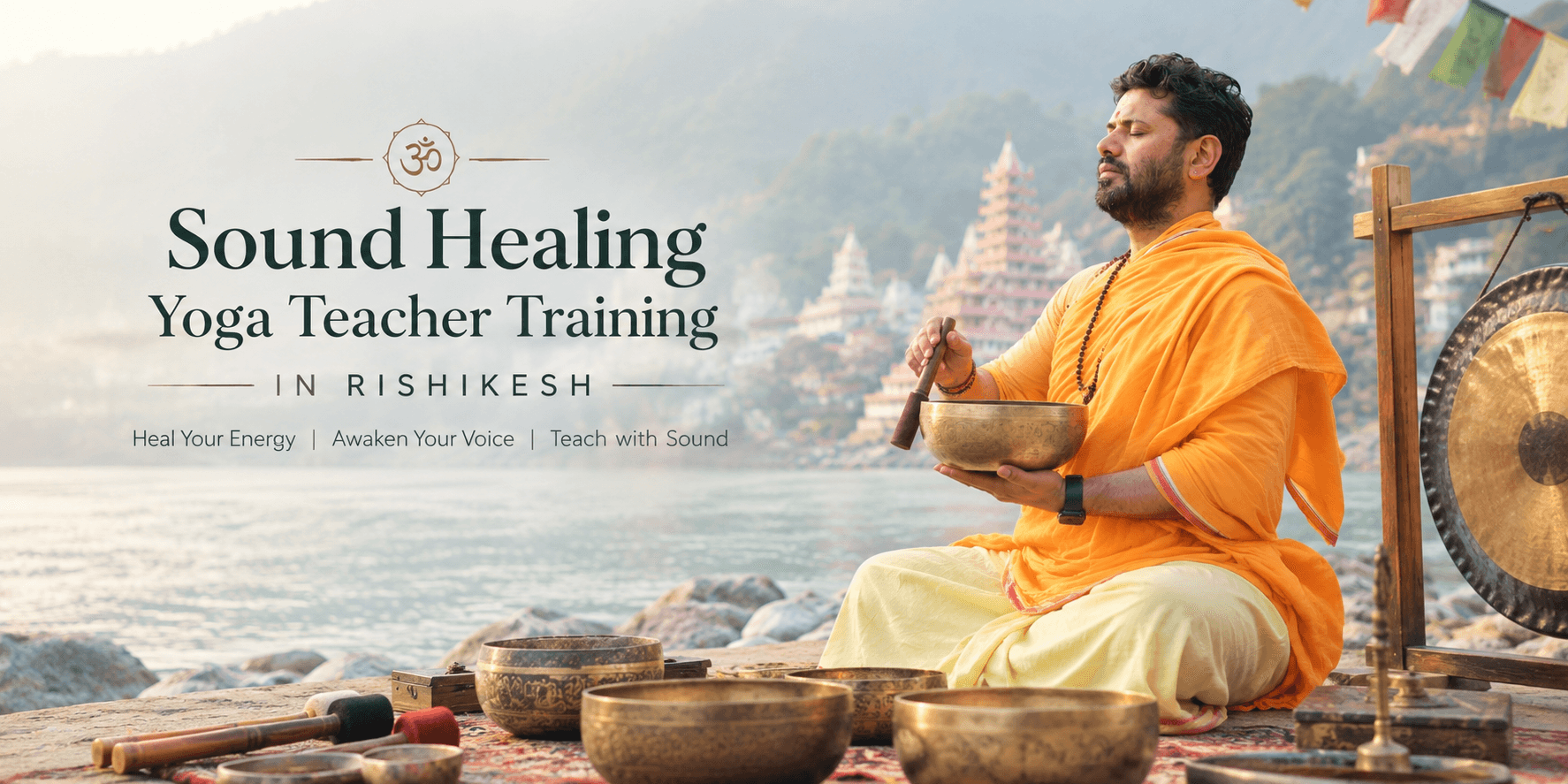
What is Sound Healing Yoga Teacher Training in Rishikesh?
- A Sound Healing Yoga Teacher Training in Rishikesh is a course or type of training for people who want to learn how sound can be used to heal the body and mind. It is a proper certification course for beginners to advanced practitioners.
- In a Sound Healing Session in Rishikesh, you will be learning about sound healing techniques and uses of various tools like Himalayan singing bowls, Tibetan singing bowls, crystal bowls, gongs, mantra chanting, and breathwork.
- Learn mantra chanting and how sound creates different vibrations and frequencies.
- Sound Healing can be a good option to opt for after completing your 200 hour yoga teacher training in Rishikesh.
- Rishikesh creates a different atmosphere with a spiritual aura. Mornings near the riverbanks of the Ganga, practising meditation and mantra chanting, can make you feel calm.
- After completing the Sound Healing Training Course in Rishikesh, India, you will receive a Sound Healing Training Course Certification from Yoga Alliance USA.
What does Ancient Indian history tell about sound healing?
Sound healing is not a new technique. For thousands of years, it has been a part of Ancient Indian culture. Many other civilisations, like Ancient Greece and Tibetan traditions, were aware of sound healing techniques.
Ancient India – Mantras and Nada Yoga:
- In ancient Indian tradition, sound healing was considered a pathway to inner awareness.
- Sacred Mantras, Vedic Chantings and Nada Yoga (yoga of sound) were the ways through which one can grow and cultivate concentration, meditation and spiritual awakening.
- OM, the sacred syllable, holds a lot of importance in many Indian traditions.
- From this, we can understand how well Ancient Indian culture understood the concept of sound healing, Nada Yoga, which means yoga of sound.
- The long history of sound healing in Indian culture is also the main reason why people from different countries want to come to India for Sound Healing Yoga Teacher Training in Rishikesh.
What do we understand by the term mantra while practising Sound Healing TTC?
The overview of the term mantra while practising Sound Healing TTC:
- While practising Sound Healing Yoga Teacher Training in Rishikesh, you will come across the term mantra, which will be a part of your sound healing curriculum.
- The meaning of mantra, which is a Sanskrit word, comes from two different elements: “man”, associated with thinking and “tra”, which is associated with an instrument or means of protection.
- While practising the Sound Healing Teacher Training Course in yoga, it is understood as a sacred syllable or word, a sound or phrase repeated continuously for a period of time for attention and intention.
- The mantras were considered a central part of Vedic rituals and oral tradition.
- The mantras were carefully passed from Guru (teacher) to Shishya (student).
- Great importance was placed on pronunciation, rhythm, accent, and memorisation.
- Over the years, mantras became an important part of yoga and meditation, and even of several spiritual paths. Due to this, the curriculum of the Sound Healing Training Course Certification includes mantras.
- Om or Aum holds great importance in Indian philosophy and is considered a sacred syllable.
- The mantra was developed through different time periods in Indian traditions, like the Vedic period, the Upanishadic period, and later in the yoga and devotional traditions.
What does the Mandukya Upanishad tell about mantras?
In the Mandukya Upanishad, the sacred syllable AUM, as a symbol, represents Brahman, the ultimate reality. Further, the Mandukya Upanishad relates to the states of waking, dreaming, deep sleep, and the transcendent.
The exact reference in the Mandukya Upanishad is found in mantras 1–7, with the relationship between Om and the four states explained further in mantras 8–12.
| Mantras | What it says |
| 1 | Om encompasses the past, present, future, and what transcends time. |
| 2 | “All this, verily, is Brahman. This Self is Brahman. This Self has four quarters.” |
| 3 | The first quarter represents the waking state (Jāgrat). |
| 4 | The second quarter represents the dreaming state (Svapna). |
| 5 | The third quarter represents deep sleep (Suṣupti). |
| 6 | Describes Prajña, associated with deep sleep, as the source and inner controller of beings. |
| 7 | Describes the fourth state, Turīya, as beyond ordinary distinctions of consciousness, peaceful and non-dual. |
| 8–12 | Explain the relationship between the four quarters of the Self and Om’s components: A, U, M, and the soundless fourth. |
What is Nada Yoga while practising Sound Healing Yoga Teacher Training in Rishikesh?
An overview of the term Nada Yoga while practising Sound Healing Yoga Teacher Training in Rishikesh:
- The Sanskrit word Nada means sound or resonance, and Yoga means the path of Union. Therefore, when the words Nada and Yoga are combined together, it forms Nada Yoga, meaning Yoga of sound.
- The philosophical foundation of Nada Yoga states that sound can be a doorway towards deeper awareness. Many schools offer a Sound Healing Course in Rishikesh that also teaches you about the foundation of Nada Yoga.
- The focus of the practitioner comes from audible sound, musical tunes, and mantra chanting.
- One of the main ideas associated with Nada Yoga is Nada Bhraman, which means the idea of understanding the sacred sound in relation to the ultimate reality.
- Nada Yoga philosophy is divided into two concepts: Āhata Nāda (sound produced through external actions) and Anāhata Nāda ( sound experienced from the inner self).
- The goal of Sound Healing Yoga Teacher Training in Rishikesh is to teach you how, as a teacher, one can produce inner sound through the practice of sound healing sessions.
Which ancient Indian texts discuss sacred sound?
This section is especially for the students who want to go deeper in the practice of Sound Healing Yoga Teacher Training in Rishikesh.
| Text or tradition | Significance |
| Vedas | Preserve sacred hymns and traditions of precise oral recitation. |
| Mandukya
Upanishad, |
Explores Om and its relationship to consciousness and ultimate reality. |
| Yoga sutras of Patanjali | In 1.27–1.29, discusses Īśvara’s designation through praṇava (Om) and its repetition and contemplation. |
| Nada-Bindu Upanisad | A later yogic Upanishad associated with meditation on sacred and inner sound. |
| Brhaddesi | An important early musicological text, traditionally dated to around the eighth century CE, that connects nāda with music and its philosophical significance. |
Why choose Sriezaa Yogshala for Sound Healing Yoga Teacher Training in Rishikesh?
Till now, we have studied what sound healing means. Now, here are the reasons to choose Sriezaa Yogshala for your Sound Healing Yoga Teacher Training in Rishikesh.
- Sriezaa Yogshala offers you Level 1 certification in the Sound Healing Training Course in Rishikesh, India.
- Years of knowledge, especially from the teachers who are the backbone of our yogshala.
- Believes in Authenticity and the yoga tradition
- Small batches designed in such a way that every student can get personal attention.
- Most importantly, at Sriezaa Yogshala, healing is not a product.
- Affordability, with accommodation and food included.
- Sriezaa Yogshala offers the best Sound Healing Yoga Teacher Training in Rishikesh.
Who should join Sound Healing Yoga Teacher Training in Rishikesh?
- Yoga teachers and students
- Complete beginners
- Meditation and mindfulness practitioners
- Therapists
- Career changers
- Wellness professionals
- Musicians and vocalists
What are the career options after Sound Healing Yoga Teacher Training ?
The career options after Sound Healing Yoga Teacher Training in Rishikesh:
- Sound healing practitioner
- Yoga and wellness teaching
- Sound bath facilitator
- Retreat and workshop hosting
- Private and online sessions
- Personal growth
- Further study
Conclusion
Embarking on a Sound Healing Yoga Teacher Training in Rishikesh is more than just earning a certification. It’s a journey into the heart of ancient wisdom and holistic wellness. Surrounded by the spiritual energy of Rishikesh, you’ll immerse yourself in transformative practices like mantra chanting, Nada Yoga, and the use of sacred instruments. Whether you’re a yoga teacher, therapist, wellness professional, or someone seeking personal growth, this training opens the door to profound healing and new career opportunities. With authentic guidance and a supportive community, you’ll leave empowered to share the art of sound healing with the world, creating harmony within yourself and those around you.
Frequently Asked Questions
- What is Sound Healing Yoga Teacher Training in Rishikesh?
It is a certification course for beginners to advanced practitioners who want to learn how sound can be used to support the body and mind. You will study sound healing techniques and the use of Himalayan and Tibetan singing bowls, crystal bowls, gongs, mantra chanting, and breathwork.
- Do I need to be a yoga teacher or have prior experience to join?
No. The course is open to complete beginners as well as yoga teachers and students, meditation practitioners, therapists, musicians, vocalists, wellness professionals, and career changers. Many students also take it after completing their 200-hour yoga teacher training in Rishikesh.
- What will I learn about mantras and Nada Yoga during the course?
You will learn the meaning and tradition of mantras, how sound creates vibrations and frequencies, and the philosophy of Nada Yoga (the yoga of sound), including Āhata Nāda and Anāhata Nāda. The curriculum also draws on ancient texts such as the Vedas, the Mandukya Upanishad, and the Yoga Sutras of Patanjali.
- Which certification will I receive after completing the course?
Sriezaa Yogshala offers Level 1 certification in the Sound Healing Training Course in Rishikesh, India.
- What career options are available after Sound Healing Yoga Teacher Training?
You can work as a sound healing practitioner, sound bath facilitator, or yoga and wellness teacher. You can also host retreats and workshops, offer private and online sessions, or continue with further study.


Discussion
0 Comments
Leave a Comment